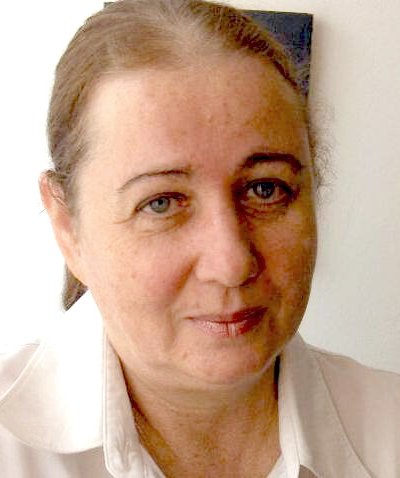
GEORGE SZIRTES
LIDIA VIANU -- GEORGE SZIRTES
I think the problem with us
Desperadoes is that we constitute too diverse a landscape for now
Interview with GEORGE SZIRTES (born
29 November 1948), British poet
Published in LIDIA VIANU, Desperado
Essay-Interviews, Editura Universitatii din Bucuresti, 2006
and in
The European
English Messenger XI/1, Spring 2002, pp. 51-58
©
Lidia Vianu
LIDIA VIANU: I
cannot help thinking of Blake and Alasdair Gray when I think of your poetry.
Blake, because he was an engraver and highly visual, though totally different
from your more modern art, closer to film than traditional painting, and Gray
because he was a painter, and also the author of a remarkable dystopia. Your
whole poetry could be looked upon as a gentle dystopia, if there is such a
thing. You create a waterfall of images which take care of their coherence
themselves. You are at the same time visual and narrative. I call this a
Desperado feature, concealing lyricism in what is apparently the property of
another art, and also mixing many genres, even arts into one. Do you feel more
than a poet – meaning, also a novelist, painter, historian, geographer – when
you think of your work? Is hybridization of genres something you have devised
deliberately, or did it come naturally, as you went on writing?
GEORGE SZIRTES:
I think you have asked the most intelligent questions I have yet
been asked and also the most difficult. You must be a remarkably perceptive
reader so I feel flattered. I will do my best to answer you.
I admired Blake enormously when
I was a student and still do. Being trained as a painter he was an obvious model
and especially attractive because of his visionary approach to Christianity. A
little background here. You may know that I am completely self-taught as a
reader and writer. My last school exams under the A level system we have here in
England, were in Physics, Chemistry and Zoology. I was a precocious learner in
Budapest and a very early reader (reading fluently by two, according to my
parents). I was also very successful in Hungarian school. When we first arrived
in England I picked up the language so fast that within a year I was top of the
class of English children. My parents’ hopes were therefore very high, and they
saw me as a doctor or an academic. However there came a period of reaction into
relative mediocrity. I think I disappeared off the intellectual map for a number
of years in my middle to late grammar school years, but because my parents
retained their earlier hopes they insisted I continue along previous lines. I
was not a good science student. I passed everything but not with high grades. At
the same time I had begun to write and, because I had time to spare, I was sent
to do Art again. Suddenly, and completely unexpectedly, I found I was good at
painting and drawing. I had dropped Art as a school subject when I was fourteen
and was considered clumsy at that stage. From the first time I read a poem
seriously, however, I knew I wanted to be a poet and now I had the opportunity
of being an artist as well. My parents were not happy about it, but I went to
art college and studied Fine Art. While studying I met my wife, Clarissa, also a
painter (and still practising as one now), fell in love and underwent a deep
religious experience of a specifically Christian kind. I was married and
baptised (by full immersion) in the same year. This was the time I came across
Blake. I had also come to admire the early Chagall (I must emphasise that it was
only the early Chagall, the later works I considered even then somewhat woolly
and sentimental). I knew nothing of Alasdair Gray.
My poetry at the time was not as
it appeared in my first books later. It was more directly ‘visionary’ and
absorbed elements of Blake, Rimbaud and was beginning to absorb Eliot too. The
poems were not dystopic: they tended towards the spectacular. Dead bodies leaked
diamonds, and so forth. The love poems (I have written these from the very
beginning) were, I think, highly sexual but, as you remark, tender at the same
time. This did not make for conventional Christianity in the English tradition,
and I distrusted the few places where it might have fitted – with the tradition
of Eric Gill and David Jones for instance.
I never made a conscious effort
to be visual, nor at that stage, to be narrative either. I think the poems were
probably over-active, overexcited. The darker side of Blake disturbed me. It was
a different matter later. The change came in the mid-seventies, shortly after my mother’s
death, as I have written elsewhere. What I was most concerned to avoid was that
which struck me as untrue. I had begun to write because I wanted to tell the
truth as I saw it: complex, contradictory, difficult, beautiful and disturbing.
That was my first and most important perception. I had not begun to articulate
the darker places of the world at that stage in my early twenties, perhaps
because I didn’t know how to, and because I believed that personal love might be
an adequate defence. Of course only half of me believed that. Perhaps I could
return to the question of dystopia later. The ‘gentleness’ seems to be a
constant quality, though, as you have seen, there are savage violences in the
poems, and, occasionally, in the voice of the poems too.
LV. A Desperado
is, more often than not, displaced. You are twice displaced: from Hungary to
England, from painting to poetry. Is displacement a source of tension or a good
starting point for poetry, in your case? Is it a reason for tension? I have in
mind writers like Ishiguro, Rushdie, Lessing, Ondaatje. To them, displacement is
a fertile wound, it keeps bleeding into fiction. Your displacement is so much
more discreet. Would you say you feel you have anything in common with other
displaced writers?
GS. This is a
very difficult question to answer from the inside. I have no doubt that
displacement is a central issue in my poems, even those that are not directly
concerned with the theme. I should perhaps feel more in common with Ishiguro,
Rushdie and the others you mention, than I do. I love the first two Ishiguro
books, and am fascinated by the last one. I think the work of W.G. Sebald is in
some way close to mine. (One of the two long poems in my next books is dedicated
to Sebald). I am uncomfortable about groupings such as the one you suggest while
appreciating that such groupings are rational steps. I have never actually TRIED
to be a foreign writer. I wanted to be an English one. The success might lie in
the failure.
LV. Your poetry
relies on sensibility and silence. You see and write, although, if you decided
to state plainly what you felt, the storm would be devastating. But you do not
really confess. You invoke kindred spirits (family and readers). Desperadoes
usually ignore confession. They prefer a no man’s land, wherefrom they
manipulate the reader unseen. You manipulate your reader by making him travel in
your imagination. Your poetry is a magic carpet flying over the earth, all
earth, even though some call it just Europe. I think you have the Renaissance
calling of the universal man (maybe this is one reason why you both paint and
write). Do you feel richer than a poet born in the land he is writing about,
knowing and writing about no other space?
GS. I often
envy the poet working in the place where he is born. Gabriel Fitzmaurice, to
whom the first of the three ‘Hungarian Sonnets’ is dedicated, is precisely that.
A lovely man, he has certain advantages, the most important of which is his
ability to resonate with the music of time and place, in his case a small
village in County Kerry, Ireland. I think of this as the kind of place where
song is born. My disadvantage is that I cannot write the songs of the tribe. I
feel excluded from it. Nevertheless I feel I know something the tribe can only
guess at, which is to my advantage. At the same time it strikes me as unfitting
and even dishonest to proclaim this ‘advantage’ as it is due to no virtue of
mine. Hence the silence. Hence too the invoking of kindred spirits. The kindred
spirits are as disorientated as I am – deep down – by life, and find it as
dreamlike. I can only hope that these spirits have a small residence in the
minds of those more deeply rooted, such as Gabriel. As to the magic carpet my
imagination is naturally wild and erratic. That is how it appeared in my first
poems long before publication. The craft of the poetry is a way of exercising
some control over them and, at the same time, showing some courtesy to the
tribes I must deal. Form is, I believe, a kind of courtesy.
LV. Your poetry
swims in many people’s works, faint echoes of T.S. Eliot, Auden, Wordsworth,
Peter Porter and so many others. What are your literary roots and who, do you
think, influenced your poetry?
GS. My first
great literary experience was in fact Eliot. I had read many other poets before
him but in The Waste Land I found a landscape that corresponded to a
certain element of my own life. More than Wordsworth, Coleridge has moved me
deeply. It may be the Germanic element in Coleridge, whose best poems remind me,
perhaps irrationally, of fairy tales and the Brothers Grimm. I loved the late
more obscure romantics, such as Beddoes and Ransom (John Crowe, the American)
because of their mannerly strangeness. I loved these more than the poets of
reason. I love the grotesque in Pope and Swift and Rochester. I must somehow
reconcile this with the tender religious feeling of Herbert. Auden is a great
hero of mine because of his gift of phrase and his lyric gift, not so much
because of his Goethean wisdom. For the same reason I admired Brodsky and Hecht
and Fenton in England. They understood darkness and could counter it with wit.
They were also Europeans, and I am, I think, above all, a European. All that is
good and all that is evil reside for me in the heart of Europe. Intellectually I
understand there may be greater saintliness and greater viciousness in Africa or
South America but none of that strikes as close to my heart as Europe.
LV. Your poems
narrate a story of solitary loss. The reader travels across images, and after a
while he realizes the images are islands which make sense, cohere into a soul.
The Slant Door claims that ‘the greater power lies in quiet.’ You are
indeed, a quiet poet, whose poetic loneliness forces a new experience on the
reader, that of isolated reading, a reading experience in which even the poet
steps aside, offering incidents and sights, expecting a totally independent
reaction. You manipulate your readers into feeling independent when they are
not. This is a very complicated dance. Are you aware of your dissimulated
technique of persuasion? Is it an instinct or an aesthetic strategy?
GS. I think you
are absolutely right and it frightens me. I think that my ‘self’, in so far as I
can conceive its existence, is a detached, hovering thing. I am acutely aware
that this is not the impression I make in person, but I think the person I have
become – the interface – is a learned process. Being so uncertain of my own
essence I feel some diffidence about offering that person as a subject. I am
sceptical about myself. I suspect it may be very important for me to remain
sceptical. Thus, I can make general observations about myself or about the
persona that appears in the poem, but I must treat these generalisations with a
certain disdain. The cavalier phrasemaker – like Porter, like Auden, like Pope –
keeps an eye on the romantic nightmarish and the sentimental lover. That is as
far as I am aware of what you call my ‘dissimulated technique of persuasion’.
But this awareness does not consciously influence the process of composition.
Such checks and balances operate under semi-conscious conditions only, and it
would be impossible to write otherwise.
LV.
Background Noises prompts the reader to do a very un-Desperado thing: ‘Hold
off the intelligence and listen.’ Irony is not a refuge for you. Your poems are
compassionate. Your lyricism is considerate. Even your pain is veiled by a
screen of decency. This is remarkable, considering the indecent rage of
Desperado poets. Your fists are clenched, but the images you draw with them are
ethereal. How do you combine the intensity of experience with the mildness of
your poetic diction? Is it your nature to be soft, or do you want your readers
to feel free from the poet’s turmoil, and just enjoy the sights?
GS. In view of
the above you might see why I want to hold off the intelligence. I think the
intelligence is too awkward an engine to probe the areas that seem important to
me. And so is the ego that might fuel me with indecent rage. I am not the only
person in the world, and the doubts I have about my own person are only valid
for me. I cannot assume that the subjectivity of others is as ethereal as mine
is. In any case I like the tangible world. Like most poets I am a sensualist of
sorts. My ‘consideration’, and I would regard it as a compliment to be
considered considerate, arises, if it exists, from childhood with a sick,
passionate, often irrational but heroic mother. ‘Whatever you feel cannot
compare with what she has undergone and continues to undergo’. One’s own
feelings enter a kind of anaesthesia, which is very much like dreaming. As a
young poet I was a soft poet who sometimes wrote hard, I think I am perhaps a
harder person now who can afford to write a little – but only a little – softer.
Relatively few of my critics / reviewers comment on my ‘tender’ feelings,
indeed there are some who cannot locate my feelings at all. They think I write
at a peculiar distance. I suspect they are right. But that is no reason why
those around me should be confronted by that distance. That is what they don’t
understand. I don’t feel I am, nor intend to be, a comforting POET, but as a man
I cannot see why I should not strive to be so. Easy comfort in art is no comfort
at all.
LV. There is an
air of life-after-death in your poems. The Shared Bath mentions the
‘intimacy of skulls.’ Your write secretive verse, and past death is your secret.
As we read along, we discover traces of unbearable violence. I have often
thought of Chagall while reading your verse. You have the same horror-struck
dreaminess. The two should not go together, but you manage to melt them in the
same pot, so the reader does not even realize that he is being initiated into
nightmare. Your poetic manner is devious. Are you writing about direct
experience (actually I know you are not), and, further, how do you make this
horror you have never experienced on your own the stuff of such intimate
emotions?
GS.
‘Horror-struck dreaminess’ is a wonderful phrase and I think you are very clever
to have used it here. I think it is absolutely right. The world is beautiful and
that is dreamy, but because it is dreamlike it is not to be trusted. There are
terrors. Whether these are terrors of my imagination or of the world outside I
do not know. I think I have been infected by terrors through my parents, but I
am not terrorised by them. It may be that one of the key intimate poems relating
to this question is ‘Against Dullness’ (p14 of Short Wave, p18
Selected Poems). In the poem my wife has just come in from the rain and has
sat down in the armchair. I remember the occasion well. The discolouration and
discomposure of her rain soaked coat and damp hair made me think for a second of
the skeleton of the mother in Hitchcock’s Psycho, but an instant later the overt
gothic horror of the film image gave way to an unwilling apprehension of the
given horror, the sheer ambivalence of the world. The last three lines of the
poem are the most important, in that they hold true through everything I have
written. The enormous pity of the world in which rain leaves such dark stains
moves me more than anything. The dystopia you mention is always a possibility:
the poems fear that it may be the true state of the world but are unwilling to
assume so. Dystopia, as an idea, is too easy, too much of a gesture. I dislike
consciously constructed dystopia for that reason. Dystopia as an apprehension is
far more forceful and credible.
LV. Your love
poetry is shy and yet bold. Is love an important topic with you? Do you think a
poet should write some love poetry in his life, or is love to be shut out of
verse? In good Desperado tradition, love is not your major issue. At the same
time, you smash it into splinters and sow it in every line. You seem to be a
most affectionate being. Do you write with your sensibility, mind, eyes, memory?
GS. My three
part ‘collected poems’ will have as its third part the collected poems on love,
desire and art, which are, for me, part of a single pattern. The equation I
automatically assume, which echoes something of Blake, says Desire is Fire and
Energy; but Love is deeper and steadier. It demands virtues whereas desire
demands chiefly energies. Life must embrace the tension between the two. By
desire I mean primarily sexual desire, but also that deep desire for whatever is
Other and alive as an idea. On this basis Death is perfectly alive as an idea.
If Blake could maintain this tension in his life it might be possible for
others. I saw how deeply my parents loved each other despite their difficulties
and furies. Yet desire must keep its edge, and live on the excitement provided
by the fear that accompanies it. I think if I failed to keep the tension up I
would be poetically dead.
LV.
The Photographer in Winter quotes Orwell in its motto. Budapest is your
dystopia and utopia at the same time. Memory is also both these things. You
cleverly resort to indeterminacy in order to keep your distance from despair. A
line states, ‘What seems and is has never been less certain.’ Your whole poetry
slips into that statement. Your poetic mood is slippery like an eel, it will not
strike roots in words. You stumble over colours and shapes, you choose the least
obvious, offensive or aggressive words, and the result is initiation into
disaster. Desperadoes are great lovers of displacement into dystopia. How would
you describe your inner world and the way you choose into poetry? What is your
aim? To warn, strike terror, soothe, entertain, or imprint your seal on the
reader’s soul forever?
GS. Budapest is
the locus of uncertainty, its emblem. I love it and distrust it as much as I
love and distrust language itself (see ‘English Words’, in Selected Poems).
Budapest is an overt carrier of historical and personal meanings. The meanings
are there in the way the statues emerge from the walls and the way the walls
collapse. I think I say somewhere in Bridge Passages (it’s in The
Flies): ‘What the wall thinks is my concern’. I don’t know how I would
describe my inner world. The poems do that. My aim? To make a world I can
believe in. I want others to believe in it too, because, for all its horrors I
suspect it may be a better, more comprehensive world than those we normally tend
to offer each other. I certainly don’t want to soothe the reader but I am not
setting out deliberately to shock him or her. I want the reader to become more
human, more humane. I want the reader to understand what the walls seem to be
saying.
LV. Your
personal history seems highly interesting, yet you never reveal it. You offer
older photographs, black and white memories, in exchange. Do you deliberately
avoid being personal? All Desperadoes do. You always find ‘bridges’ to cross the
river of life into hell. How do you manage to deal with serenity with such
experiences that, if put into direct words, would make anybody’s hair stand on
end?
GS. I do avoid
being personal. I don’t want to get in the way of the walls. I am really not
important and that is the central paradox of the poems: we are vital yet we
don’t matter at all; death is terrible but it is the most natural thing in the
world. These are very common sense paradoxes really. I don’t talk about myself
because I think I am as lucky as a man can be. I have an apprehension of the
terrible which is unusual in the way it has developed, but I don’t feel I am a
victim of it. It is precisely because I am not a victim that I feel a certain
responsibility to those who genuinely are. I have very little patience with the
cult and cultivation of victimhood.
LV. In The
Courtyards you write a few lines which sum up the mood of your whole poetry:
‘As if the past could ever lose its teeth:/ As if the eye could swallow
everything/ and leave the world in darkness.’ The intensity of your sensibility
drains the reader, and also regenerates him, gives him strength. I should
describe you as a very vital poet. What is the source of this vitality? Your
nature, your art, your having survived a hell so many fell into, your narrow
escape from communism?
GS. I can only
hope for vitality. I feel vitality but cannot ever be certain that I can convey
it. I am far from being a shamanistic poet, or perhaps it is simply that I think
it is bad luck to talk of powers when all you might have are desires, but that
does not mean that I don’t think poetry has a genuine healing function. It does,
but not as therapy. The great healing act of poetry is to bridge the gap between
language and what happens. That is its project. But it would take a monster, a
fool, or an egomaniac to think that he or she was actually succeeding in healing
the world or even to consider the healing of the world as the project of their
verse. I am not only sceptical about my own altruistic motives but am as
superstitious as any other real poet about such things. My tutor at Leeds was a
marvelous poet called Martin Bell. He once told me he could cast a curse on
someone and bowed three times each night to the moon. I don’t think he was in
the least foolish. Even answering all your questions may be flirting with bad
luck.
LV.
The Child I Never Was states, ‘The child I never was makes poetry.’ You do
look at the world with the tolerance of a helpless child. You do not expect your
reader to explore your text, the same as you do not mean to explore innovation
as a full time activity. You are not mainly interested in technicalities. What I
think your really are after is to secure a tender surrender to your poetry. The
reader must use his intuition. Eliot used to say that poetry could communicate
before it was understood. You are past him, you are a Desperado, which means you
are keen on making yourself understood. Clarity is a prerequisite with
you, but depth is another matter. Would you contradict me if I stated that you
never write as a child, but as a very shrewd painter? That you are very much
aware of your art? That you mix literature (poetry and fiction), painting,
photography, meaning to get thereby a unique species?
GS. Yes, you
are right, there is a helpless tolerant child there, and I do hope to secure a
tender surrender. That, I think, is the Eros of poetry. And of course there is a
perfectly shrewd adult individual watching the helpless tolerant child. I would
be nothing better than a con-man, a bare faced liar, if I pretended to be
nothing but a helpless tolerant child. Do you know the Sindbad stories of Gyula
Krudy? I translated them into English. Sindbad the hero is a three hundred year
old amorist. He is both a child who wants to please his mother and an ironic old
ghost who revisits his seductions. I am not quite a ghost yet and I know I am an
adult male and father of two grown up children. In this respect I understand
pretty well what I am. Clarity is precious, but depths – it is their nature –
are murky. I have no conscious project to create a single art out of literature
and the things my own literature refers to. The other arts are illuminating. I
want the clarity to go as far down as it possibly can, and the other arts help.
LV. Your mother
was born in Cluj, I think. Since I live in Romania, I have a predictable
question: After visiting Romania, probably after meeting your one Romanian
relative, how do you feel about it as a country, a space of the past and of the
present?
GS. When I
first visited Romania in 1993, it was a very dark and disorientating experience.
I was shocked by the conditions people lived in, by their fear and
demoralisation, by the sheer physical chaos. It was what I sometimes feared my
own mind could become. I wanted to get out. The poem Transylvana was the
result. Its horrors are part-comical part-lyrical. When I revisited in 1997 on a
British Council tour and attended the conference at Oradea, conditions had
improved somewhat. As often happens with poets’ imaginations, place and person
overlap. Romanian Brown is a mixture of landscape, politics and
enchantment. It was an echo of some chaos in myself, therefore exciting. I very
much liked many of the people that I met on my tour. Romania’s material state,
its history and its current position are only relatively familiar to me, but I
have read a number of Romanian poets: Tartler, Dinescu, Crasnaru, Sorescu, Nina
Cassian and Denisa Comanescu, among others, and my sense of Romania is coloured
by them. Whether this is a valid sense of place or not I cannot tell, but it
seems potent.
LV. You talk
about ‘the accident of being who one is.’ You have crossed the iron curtain and
were brought up in England. Which is not always the same as saying you are an
Englishman. How well have you adapted to your country of adoption? You are
haunted by a past ‘which remains forever another place.’ Your poetry strives
back to Budapest and the lost family. Where exactly do you belong, where do you
feel at home?
GS. I don’t
know the answer to this one. I am trying to answer it for my own sake. The next
book is an attempt to do so. I feel the typical patriotism of the immigrant. I
am fiercely defensive of England. At the same time I recognise I am not of it
nor will ever entirely be so. I want to love the people and the land and the
history and the culture and I am partially successful in this. At the same time
there is much I do not like and feel limited by. I regret its caution, its
empiricism, its insularity, its class system, its leadenness, its general middle
greyness. But it is also the country of eccentrics, of mad heroic projects, of
extraordinary inventions, or remarkable tolerance. And it offered and continues
to offer safe harbour and stability to many, including myself. My good friend,
the Hungarian poet Ottó Orbán, drew a little picture for me by way of dedication
to one of his books. He showed a cloud between England and Hungary, with an
arrow saying ‘You’. Maybe. In the last section of the biggest single poem of the
next book (25 poems in 5 sections, all in terza rima) England is destroyed by
five apocalypses. I myself don’t know what to make of this, but I wrote it and,
I think, wrote it as well as I have ever written anything, so it must mean
something to me.
LV. Just like
Chagall, even though you never write about it very explicitly, the tragedy of
the wandering Jew is the central theme of your sensibility (if I am not wrong).
As a line says, ‘The crematorium waits, the oven burns.’ Your horror goes beyond
the pogroms in Chagall. If the Russian painter was flying above a nightmarish
village, you have a whole ‘holocaust’ to hover above, and the task is
exhausting. So you conclude by feeling ‘The horrible familiar stench/ Of loss.’
A true Desperado, you assume and intellectualize history. But now, in an
interview, not in poetic language, how do you feel about this particular
history, which has darkened the life of your family, even yours, your memories
at least? How come your poetry never flares against this injustice, just
registers it in whispers?
GS. ‘Poetry
makes nothing happen’ wrote Auden. ‘It is a way of happening. A mouth.’ This may
not always be true but sometimes I think it is right for it to be a way of
happening and a mouth. It is quite certain that the lives of people of my
parents’ generation and location were lived in conditions of insecurity, murder,
paranoia and genocide. The darknesses of my life are less definable than theirs.
The Holocaust’s shadow does not lie directly across my face as it did on theirs.
It does not look so well, so right, on me. If I want to fight against injustice
I feel I should do so through actions. My generation is capable of action. But
action is ambivalent and dangerous and I feel it is therefore very important to
talk in a clear level tone. I hate being swept away on potentially false
emotions, even when generated by myself. I have an apprehension of disaster. I
have not deserved a medal for surviving it.
LV. In A
Greek Musée, you describe life as a ‘footnote/ to unwritten literature.’ It
makes me think poetry is vital to you. The reading experience you prepare is far
more important to you than your own life, which is to be used as a footnote, not
as a major code. Your poetry is and yet is not at all autobiographical. You
decant real life into words, for the benefit of those who read you. What is your
image of your ideal reader?
GS. Yes, poetry
is vital to me. I equate it with truth and I feel truth to be wonderfully and
dangerously complex. I feel uncomfortable talking about my own life in literary
terms. It seems I have been to certain places and seen certain things, but the
meaning of these things is complex. My ideal reader is someone capable of
sensing the complexity – the paradox of the preciousness yet disposability – of
what happens and to whom it happens. I would like the poetry to heighten his or
her sense of their unique tiny position in the world. To turn my life into an
anecdote would be to lie about it.
LV. English
Words states, ‘I cannot trust words now.’ You are everywhere mistrustful of
words, pushing meaning into image, incident, history. The word is replaced by
understatement. What is your reaction when critics (and interviewers) probe your
texts in hopes of finding something intelligent to say? Are you angry? What is
the ideal critic like, in your expectations?
GS. All I
expect of my critics is intelligence and a careful ear. Then they can say what
they like. I say this without any flattery but you seem to me amongst the most
intelligent and understanding of my critics. I trust you to respond in whatever
way suits you best. I am not the keeper of a secret that others must solve. I am
not a setter of crossword puzzles. I don’t know the answers myself. I don’t even
believe there are firm answers to the questions people ask of literature or
writers. There are only more or less convincing readings, including the writer’s
own. Nor can we always be sure why we find one reading more convincing than
another. I suppose it would help if the critic felt something of the gentleness
with which I would actually like to treat the world. It is not that the world is
treated gently in my poems, it is simply that the desire to treat it gently
matters. It has had a pretty rough time. There are human creatures living in the
big, rather dark, but mannerly structures of my poems: those structures are
supposed to represent the structures of a possible real world.
LV. In
Transylvana you write, ‘The dead/ drive dangerously among the living.’ Your
poetry is such a race, a risky race (you state somewhere you love taking risks),
a challenge to text-diggers. The result is, in Soil, that home ‘is
nowhere to be found.’ You are fifty-two now. Between displacement (in childhood)
and your permanent dystopic memories, have you at last reached the feeling that
you belong, and that your world is acceptable? How would you describe yourself
as a poet today, in English literature, in England as a space, among (the) other
Desperado writers in England?
GS. The risks I
take don’t look that much like risks at first sight. I am not an avant-gardist (I even think it somewhat too
safe being an avant-gardist). I am polite, even courteous in my writing. There
is, perhaps, an air of diffidence. The risks are to do with speaking quietly and
walking in big buildings. I sometimes think of my poems as buildings, in fact of
the whole project as a building (a tenement block perhaps) somewhat to the side
of the main stream of English verse. I don’t fit most of the available
categories, but I don’t seem to make a fuss about it, so people hardly notice I
don’t fit. I don’t speak FOR a specific group or tribe so am not, as one friend
at the BBC once told me, USEFUL. I am, therefore, a semi-derelict building round
a bend of the river. I think I am resigned to this. I think the problem with us
Desperadoes, to adopt your term, is that we constitute too diverse a landscape
for now. It might be – and I must live in that hope – that the landscape we make
might later appear more substantial in its weirdness, and that someone sometime
might make a proper city of it. In the meantime I am fortunate to be able to
build anything at all, and even more fortunate that it is at least visible from
the river. Nobody has ever suggested that I can’t build.
LV. Your poetry
is a ‘craft’ which your have learnt, as you say. Your music is discreet and
haunting. You write sonnets, you do not abuse rhyme, on the contrary, it seems
to me you do everything in your power to conceal it. Yet you feel you have to
use it, to continue the craft. The poetic tradition means something to you. The
blend of tradition and Desperado leads to a chameleonic text, which requires
subtle readers. Subtlety is one of the major features of your poetry. Subtlety
is the major Desperado mood. Whatever they do, they want to do it
unnoticed. You are a concealed, devious, highly resourceful Desperado. At
the end of this interview, would you flatly reject this label, maybe hesitantly
accept it or suggest another?
GS. If that is
what a Desperado is then I accept the title. I am puzzled however as to how one
should reconcile the deviousness with the clarity. Or is that just more
deviousness?
February 10, 2001